ENDEAVOUR STRAIT SEA CLAIMS – FACT SHEET
CAPE YORK LAND COUNCIL
14 August 2026
Reason for this fact sheet
1. There are two overlapping native title claims for the Endeavour Strait Area before the Federal Court. These are:
- (a) the Ankamuthi People Sea Claim (proceeding QUD356/2025); and
- (b) the Gudang Yadhaykenu People Sea Claim (proceeding QUD357/2025).
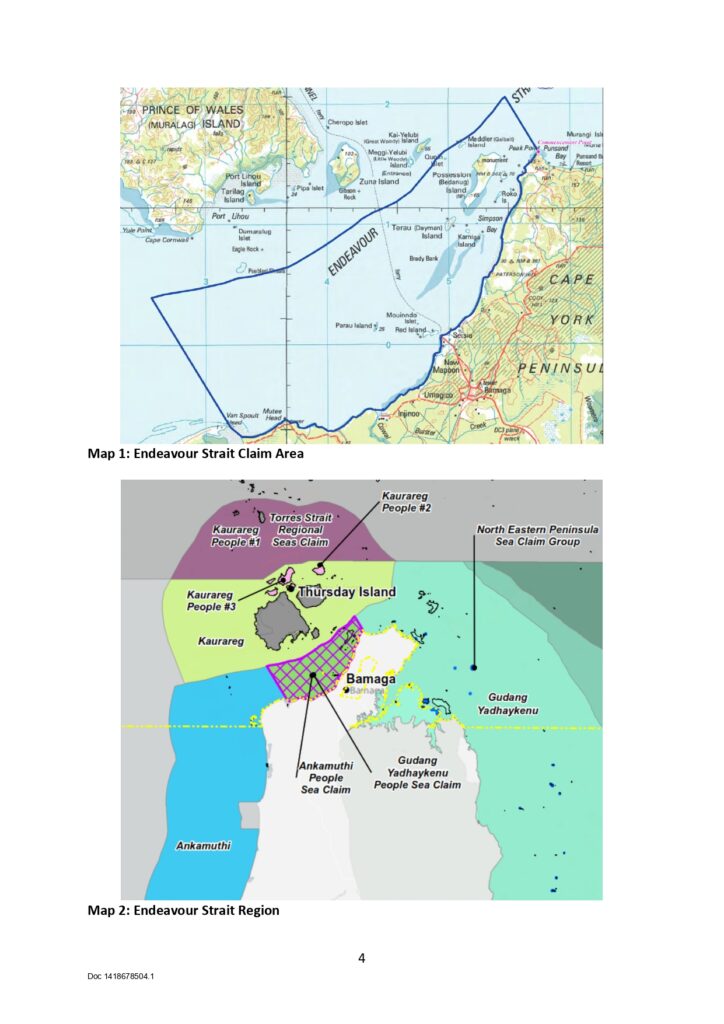
2. The claim area for each claim is the same and is shown in Map 1 below.
3. The claim area of each of the Ankamuthi People Sea Claim and the Gudang Yadhaykenu People Sea Claim is surrounded by determinations of native title that the Federal Court has already made, as shown in Map 2 (Endeavour Strait Region) below. These are:
- (a) in the west, a determination of native title in favour of Ankamuthi People made in David on behalf of the Torres Strait Regional Seas Claim v State of Queensland [2022] FCA 1430 (the David Determination) on 30 November 2022;
- (b) in the north, running along the middle line of the Endeavour Strait, a determination of native title in favour of Kaurareg People made in the David Determination;
- (c) in the east, a determination of native title in favour of Gudang Yadhaykenu People made in the David Determination;
- (d) in the onshore area in the south, a determination in favour of Ankamuthi, Gudang Yadhaykenu and Atambaya People made in Woosup on behalf of the Northern Cape York Group #1 v State of Queensland (No 3) [2014] FCA 1148 (the NCY#1 Determination) on 30 October 2014 (and effective on 2 April 2015). Ipima Ikaya Aboriginal Corporation RNTBC holds the native title determined in the NCY#1 Determination on trust for the benefit of Ankamuthi, Gudang Yadhaykenu and Atambaya People.
4. On 6 August 2026, the Federal Court requested that Cape York Land Council (CYLC) provide objective information about both the Ankamuthi and Gudang Yadhaykenu Sea Claims to the communities involved in the proceedings.
What are the Ankamuthi and Gudang Yadhaykenu Sea Claims about?
5. The claims are about whether Ankamuthi or Gudang Yadhaykenu (or neither or both) hold native title rights in the claim area.
6. Because the Ankamuthi and Gudang Yadhaykenu do not agree about who holds native title, it is necessary for the Federal Court to conduct a trial about each claim. This means the Court will hear all of the evidence and argument on behalf of the Applicant for the Ankamuthi and the Applicant for the Gudang Yadhaykenu, who each represent each of their claimant groups, and also from any other party in the proceeding who participates in the trial, such as the State of Queensland.
7. After hearing the lay-witness evidence in Bamaga and Cairns in September, the Court will hear evidence from the experts retained by each of the Applicants in Cairns in December 2026, before hearing closing submissions in Melbourne in February 2027. The Court will then adjourn to give the Chief Justice time to make a decision. The Federal Court will then issue a judgment in which it sets out its weighing of the evidence and conclusions about who holds native title in the claim area.
8. A trial about the existence of native title always involves the Court considering the applicable traditional laws and customs of an area, and the history of Indigenous occupation and use. Each of the Applicants who represent the Ankamuthi and the Gudang Yadhaykenu will present that kind of evidence in the trial.
9. It is important to remember that any determination made in relation to these two claims cannot change or vary what the Court has already decided in earlier claims, such as the 2014 NCY#1 Determination.
10. A decision about the Ankamuthi People Sea Claim and the Gudang Yadhaykenu will only be about whether native title exists in the claim area of those two claims, and if it does, who holds it and what the native title rights are.
What the Endeavour Strait Claims are not about
11. The Endeavour Strait Claims will not affect any of the adjoining determinations of native title listed at paragraph [3] above.
12. Issues about the ownership of onshore land in the Northern Peninsula Area, the existence of leases or the payment of compensation for past land dealings that affected the native title determined in the NCY#1 Determination are all examples of things that the Endeavour Strait Claims will not deal with.
Importance of respectful conduct
13. The Federal Court process is a formal and solemn one. All court participants (whether native title claimants, government representatives, individuals, or commercial parties) are required to conduct themselves politely and respectfully when in Court.
14. The requirement for polite and respectful conduct is the right thing to do, but it also serves a practical purpose. The Court must be fair to all parties, and to do so it must give a fair chance to each party to present their best case (their best evidence and best legal argument). Polite and respectful conduct is one way the Court ensures that parties in Court have a fair opportunity to present their case.
15. Polite and respectful conduct extends beyond the court room. That includes witnesses and members of each native title group, whether they are part of the Ankamuthi Sea Claim or the Gudang Yadhaykenu Sea Claim. No one should be discouraged, threatened, or treated badly, because they want to give evidence in favour of Ankamuthi People or Gudang Yadhaykenu People.
16. Polite and respectful conduct is expected, not just in face-to-face dealings between parties, witnesses and members of each native title group, but in all settings, including on social media platforms, over email, and via telephone. In the course of those dealings, parties should be careful not to discuss sensitive or confidential matters relating to each claim.
Further information
17. The Applicant for each of the Ankamuthi and Gudang Yadhaykenu claims are legally represented. Any member of either group should approach the legal representative for their group if they have legal questions about either of the claims.
18. CYLC cannot provide legal advice to members of either of the Ankamuthi and Gudang Yadhaykenu claims about their respective claims, but can answer general questions about native title and assist existing PBCs (such as Ipima Ikaya) in fulfilling their responsibilities under the Native Title Act 1993 (Cth).
19. For general information about native title, traditional owners should contact Cape York Land Council on free call 1800 623 548 or info@cylc.org.au.